In our Solar system, life as we know it, is only possible on Earth.
Our blue-green planet circles the Sun at exactly the right distance for life to exist. The Sun's energy warms the planet from the cold of space. The water vapour which evaporates from our bountiful oceans and the little carbon dioxide from our respiration enriches our atmosphere to keep in just enough heat so that life on Earth not only survives, but thrives and flourishes.
In the future this may not be the case.
Organic life is only possible at certain temperatures. Since the last century temperatures have been rising consistently, and indeed over the last few years, this rise has accellerated. If it continues, at some point, life on Earth will no longer be possible.
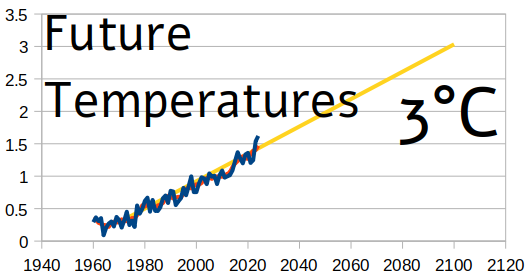
Temperature of the Atmosphere at ground level
As can be seen, ground level temperature, measured against the average for 1850-1900 has risen almost linearly since 1960. Extrapolating it at the same rate to the end of the century, we get about 3 degrees above pre-industrial levels, see figures above.
Consequances of higher temperatures
Most academics believe that the diversity of life we experience on Earth will be severly curtailed with not much more than a 3 or 4 degree temperature rise.
- At 2 degrees C above pre-industrial temperatures, 99% of all coral reefs on the planet will become extinct.
- At 3 degrees, we see the threat of food system collapse, with major disruptions to agriculture and widespread famine risks.
- At 4 degrees, we predict risks to human survival with large parts of the planet becoming uninhabitable.
Increases of Carbon Dioxide in the atmosphere causes temperature to rise
In 1896 Nobel prize winning scientist Svante Arrhenius discoverd the effect of Carbon Dioxide in the atmosphere on temperature. This is because Carbon Dioxide traps heat in the atmosphere. There has been a strong academic consensus on CO2 and global warming since the 1970s, with the consensus building as the evidence solidified. The scientific consensus is that human influence is the principal driver of observed climate change.
- 1970s: Scientific assessments started and scientists increasingly predicted warming.
- 1980s: Evidence from ice cores and other research began to solidify the link between CO2 levels and temperature, leading to the formation of the consensus.
- 1990s: The first IPCC report stated it was certain that human activities were increasing greenhouse gases and causing global warming, a view supported by research from that time and beyond.
- Present: The consensus is overwhelming, with studies showing that over 99.9% of peer-reviewed scientific papers agree that climate change is human-caused.
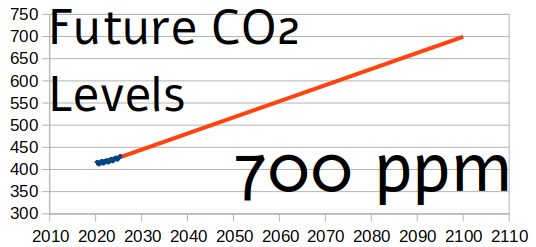
This has been measured since 1958 at the Mauna Loa Observatory in Hawaii. More recent studies have confirmed this effect and show that the rate of increase if anything has been speeding up. There is no sign of any effect from any recent efforts at Net Zero, the Kyoto Protocol or the Paris Accords. All of which aim to keep warming below 1.5 degrees Celsius. The extrapolated rate of increase, if not checked, hits about 700 ppm by 2100, see figures below.
Carbon Dioxide emmissions and Carbon Dioxide levels in the atmosphere are both increasing.
Carbon Dioxide emissions
Emissions have increased very rapidly year-on-year from the 1960s. Since 2020 there has been a levelling off of the increase. Despite this levelling off, Carbon Dioxide is still being injected into the atmosphere at a rate of 40 Billion tonnes per year.
Carbon Dioxide Levels
The key issue with Carbon Dioxide levels in the atmosphere is the time taken for it to disperse once emitted. Even if emissions reduce substantially, the level of Carbon Dioxide in the atmosphere will continue to increase annually.

Sea levels show a similar trend rising about 30cm per century.
Each of the last 10 years have been among the hottest 10 years in the UK since records began in 1884 and the majority of the worst years for farming have all been since 2000.
Based on the provided data and current trends, every fraction of a degree of warming dramatically escalates threats. At 1.5°C, farming faces increased risks for major crops like maize, wheat and rice. At 2°C, these become significant yield reductions, raising malnutrition risks. At 1.5°C, we face severe heatwaves and major ecosystem loss. At 2°C, these impacts intensify, with near-total coral reef loss and significantly more people exposed to extreme heat.
Current pledges put us on a path to ~3.0°C, where farming confronts major disruptions and widespread famine risks. A 3°C world threatens food collapse, with catastrophic consequences for global food security. We risk triggering irreversible tipping points, mass extinction and widespread food and water crises. A 4°C+ world early in the next century would threaten the collapse of systems essential for human civilization.
Public Engagement on CO₂‑driven Climate change
The results of a survey conducted by Surrey County Council are shown in the figure below:
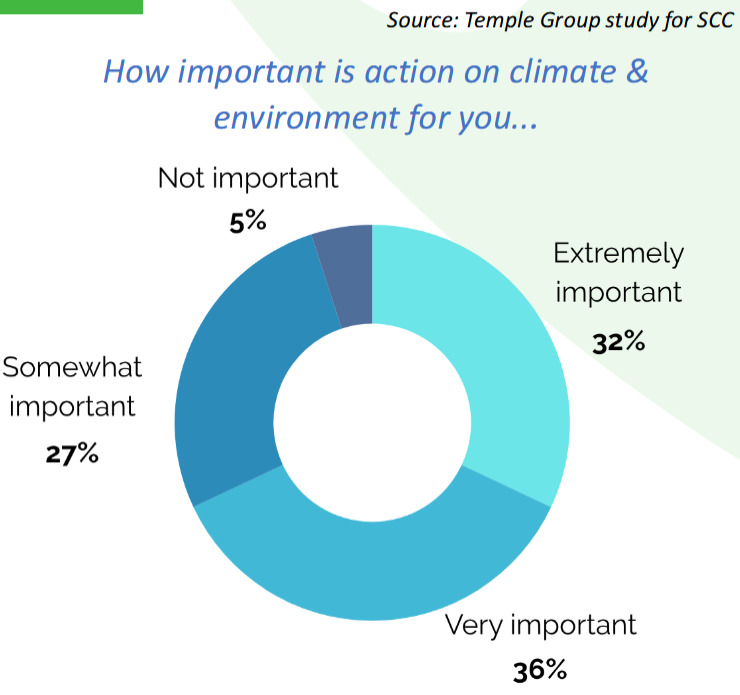
A third of local residents think Climate Change is “Extremely Important”. There is a link between shrinking crop yields and increasing atmospheric CO₂. The link between CO₂, temperature and crop yields is not intuitive and this is the core of our problem.
Local Democracy and Action
Surrey County Council is supporting residents to reduce emissions. At a “Green Futures” workshop, the SCC facilitator said 100% of its initiatives came from local action groups. But clearly reducing emissions is not enough and the response nationally is patchy. However we have hope.
CO₂ Matters UK
CO₂ Matters UK is a UK‑based environmental charity founded in Crawley with a mission to use evidence and real data to raise community engagement about the threat of increasing carbon dioxide levels in the atmosphere.
Current UK engagement appears to be in the 30%–35% range (or less) but probably needs to be 50% or more to support policy-makers locally and centrally in their policy decision‑making and to advise on investment about carbon reduction, capture and reuse. This organisation focuses on providing tools and education based on real data and advocacy to ensure engagement. We hope other countries might follow our lead.